The only opening rule
Choose one offensive stat and make it reliable. If your opening kit centers on Punch, prioritize STR. If it centers on Spark, prioritize INT. Once damage is functional, use HP, VIT, or RES to survive the turns your rotation cannot skip.
A flexible 12-week route
Weeks 1–3: establish the engine
Compare your starting skill, available meals, and weekly actions. Use the first block to strengthen one offense and learn how the current run is offering money, items, and Skill Inspirations. Players recommend Punch → STR or Spark → INT as the simplest opening fork; see the source-linked field note.
Weeks 4–6: buy survival
Add the defense that matches your actual problem. HP gives a larger error budget; VIT answers physical pressure; RES answers magical pressure. Do not raise all three equally by habit.
Weeks 7–9: complete a rotation
You begin with four battle-skill slots. Aim for one repeatable damage action, one defensive response, one recovery or mitigation tool, and one flexible slot. Stagger cooldowns so two bad turns do not overlap. A strongly RULE-aligned event can later grant a fifth slot.
Weeks 10–12: test, then correct
Take a fight that exposes the build. If the forecast forces repeated defending, the issue may be speed or defense—not more damage. If safe turns pass without pressure, improve the offensive engine.
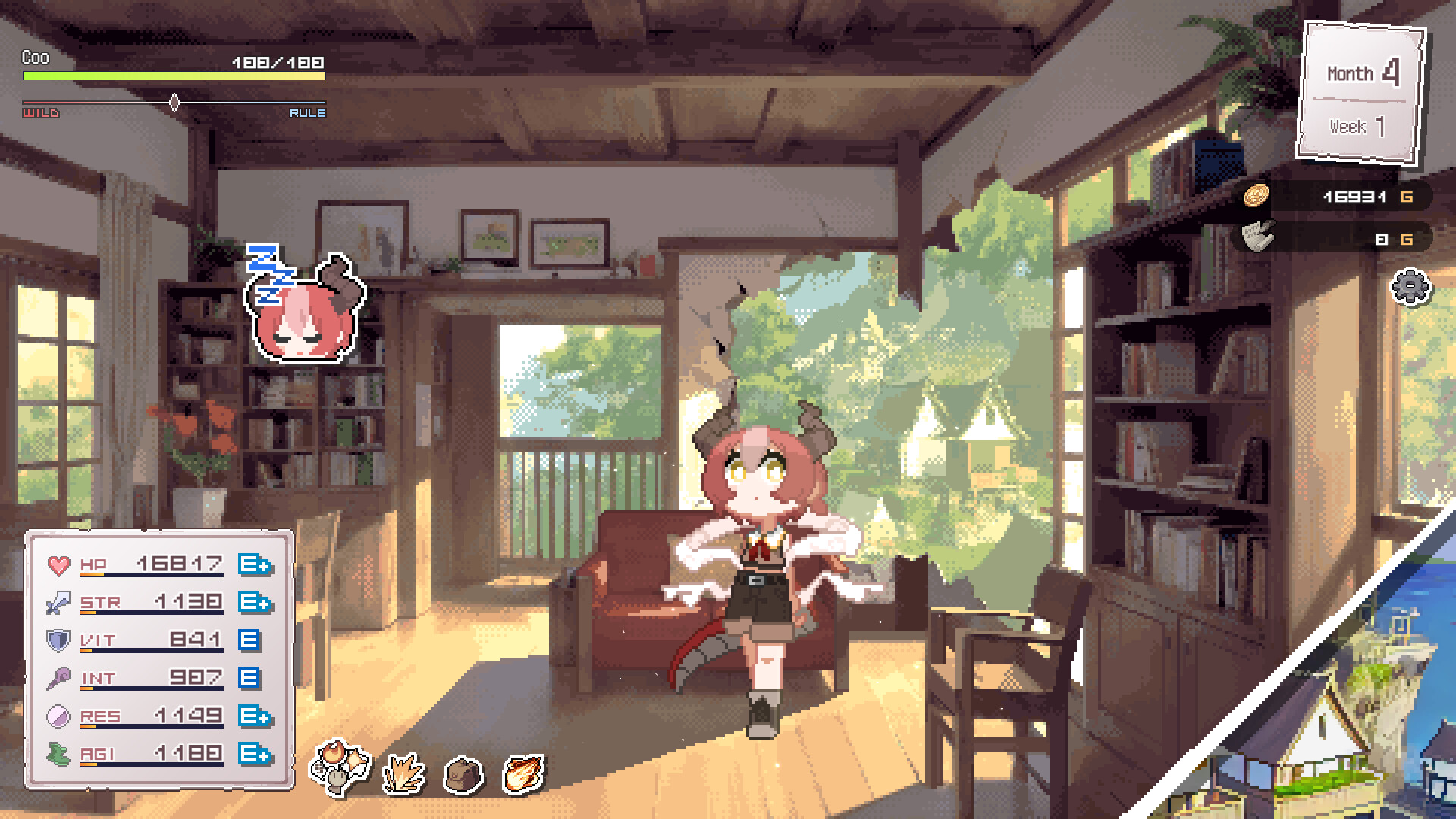
Stats, without folklore
AGI is strongest when acting earlier changes the turn. A faster heal before incoming damage is valuable; a faster attack that still cannot finish the enemy may not be.
Read the battle forecast
Enemy intent is visible. That makes combat a scheduling problem: block the dangerous turn, attack into the safe turn, and avoid spending a long cooldown immediately before you need it.
Three expensive mistakes
- Splitting STR and INT early. Two incomplete damage plans compete for the same weeks.
- Resting without a reason. Stamina matters, but a rest still spends one of the run's limited actions.
- Collecting skills instead of building a rotation. Cooldown coverage and synergy beat inventory size.
For concrete next steps, open the feeding and CP guide: food families by stat, stamina budgeting, villager skill access, and loop-bonus planning.